

Where is market research heading? And what stays human
AI is changing market research fast. You can ask ChatGPT a question and get an answer in seconds. So why would you still need a research agency? And what should you watch out for?



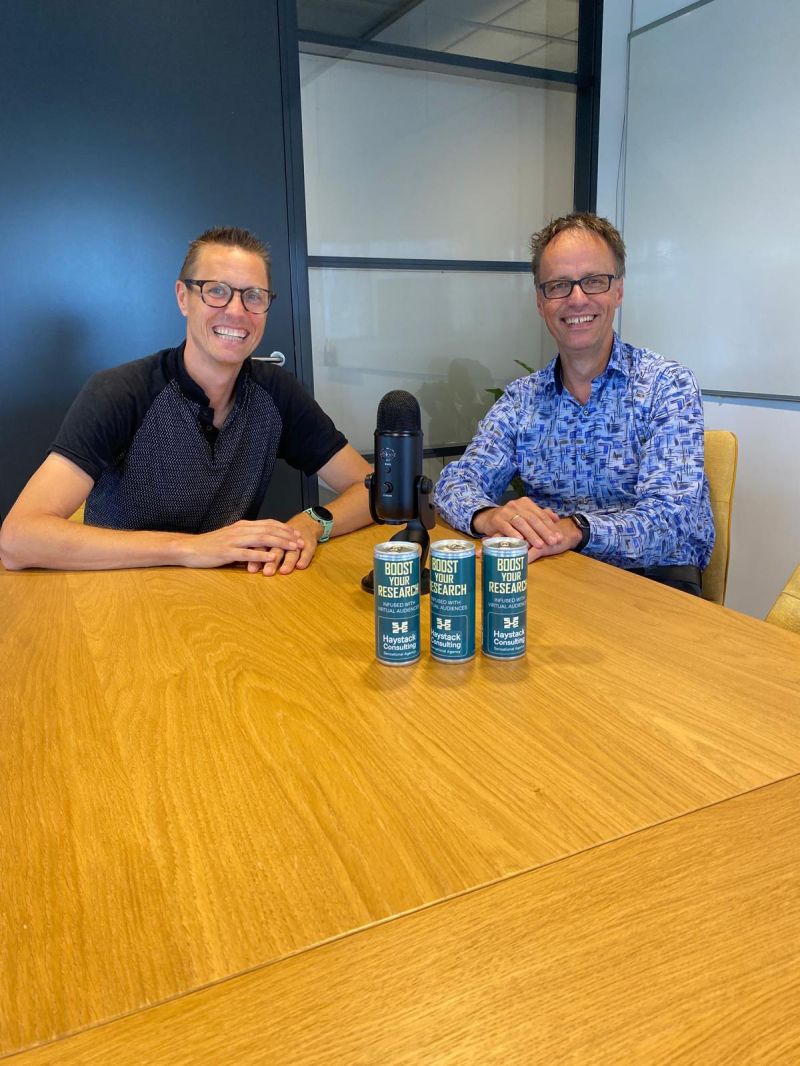
In this article you get three things: the big shifts we see in our profession, what they mean for your decisions, and how we at Haystack Consulting combine human understanding with AI speed to help you choose better. The article is based on a conversation between Stefan Peters (Haystack Consulting) and Ewout Witte (Marketing Intelligence Network) in the podcast Marketing Intelligence Inspiration.
Shift 1: You are taking the wheel
More and more companies run their own research with do-it-yourself platforms and GPTs. Your knowledge base becomes a living thing that keeps growing. That is good news: you get answers faster. But there is a catch. The answer you get depends on the question you ask. Writing a good prompt is close to writing a good questionnaire. That has always been the craft of market research. Many client teams have strong researchers. But many marketers spend about 90% of their time on other things. For them, "I'll just ask ChatGPT" is tempting. The risk is a fast answer to the wrong question.
Shift 2: "Good enough" is winning
There is a lot of debate about synthetic data. Is the quality good enough? That is a useful debate. But the shift will not stop. History shows that tools with "only" 80% of the quality are often fully embraced, because they are faster and cheaper. So, the real question is not if you will use AI in research. It is how you make sure you can trust what it tells you. For research agencies this is serious. Market researcher is often named among the jobs most at risk from AI. As Stefan puts it: “We all need to keep evolving”.
So, what is left for a research agency?
Our answer: AI for speed and scale, people for context, judgement and direction. That is our promise. Human understanding. AI speed. Creating value that matters. Here is how that works in practice.
Virtual Audience: qualitative research in days, not weeks. We build synthetic personas from a large data lake, web data and behavioural science. Five large language models check each other, so hallucinations come to the surface and get removed. You get qualitative insight in a few days instead of about six weeks, at around 40% lower cost for consumer target groups. Validation studies show the same outcomes as research with real people. And when you are hesitant, we first rebuild part of an existing study so you can compare.
Digital Twins: more tests with the same expert panel. Sensory experts rate products on up to fifty dimensions. We train a model on their historical scores, so we can predict how each expert will score. That means 20 to 30% of the experts no longer need to attend each session. You can run more tests, even when panelists are ill or your capacity is tight.
A predictive brand model: see what happens before you act. We combined How Brands Grow with the Semantic Brand Score. The result shows at which moments your brand matters, where you should steer, and what that does to your market share. A simulator lets you explore: What if we do this? Or: what if our competitor does that?
In all three, AI and machine learning do the heavy lifting. Our consultants make sure you ask the right question and know what to do with the answer.
We use it every day ourselves
We don't just sell AI. We work with it. In our team meetings we share best practices of Claude, ChatGPT, Gemini or, so we learn from each other. Almost everyone in our team uses these tools daily. Some of us, like me, even call ChatGPT or Claude in the car to prepare e.g. a client meeting.
At the same time, some things stay human. Our expert panels still taste beer and other products in person. Ones and zeros can't taste.
What this means for you
- Try things yourself. The best way to understand AI in research is to use it.
- Check before you trust. Ask how an AI answer was built and validated. Fast is only useful when it is right.
- Use AI to explore, then decide with confidence. Synthetic research is great for exploring, testing and giving direction. For big investments you may still want the human numbers.
- Keep people in the loop. AI gives you speed. People give you context and the "so what".
Curious how human understanding and AI speed can help your next decision? Get in touch with Stefan Peters. Or listen to the full conversation in the Marketing Intelligence Inspiration podcast (in Dutch) on Spotify.

Reach out to our expert on the matter

