

From visibility to meaning: what brands must get right at the olympics
I went to Milan expecting Paris. That was my mistake. Two years ago, I attended the closing ceremony of the Paris 2024 Olympic Games. Paris was electric. The city itself was the stage. The Olympics were everywhere — on the Seine, under the Eiffel Tower, in the streets. Last week, I landed in Milan expecting something similar. I didn’t find it. Milan is iconic. Elegant. Cultural. But the Winter Games — largely happening in the mountains — don’t spill into the city the same way. There’s no constant buzz. No mass street gatherings. No collective roar like during a World Cup. At first, it felt flat. Then I realised: maybe I was looking for the wrong thing.


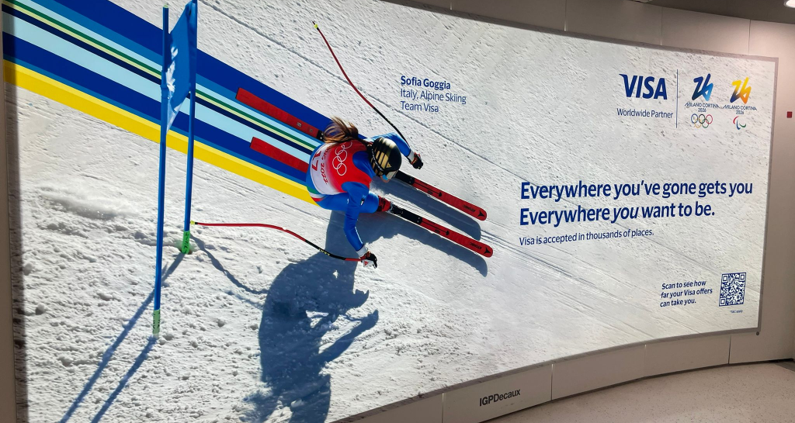
The Olympics don’t activate cities. They activate brands.
Winter Olympics are structurally different. Fewer team sports. Fewer collective rituals. Less synchronized cheering.
If a football World Cup is emotional combustion, Winter Games are controlled performance. They’re about precision. Endurance. Individual mastery. Performance under extreme conditions.
And that changes the sponsorship logic. Brands can’t rely on ambient energy. They have to bring their own.
Every brand has to find its platform within the platform
The Olympics are not one opportunity. They are multiple layers of opportunity. And each brand wins differently.
Visa wins through utility. Every frictionless payment reinforces trust. Quiet. Structural. Effective.
Samsung wins through integration. Innovation and performance naturally fit the winter narrative.
Nike wins through athletes. Individual mastery is its natural territory.
Stellantis wins through symbolic fit — engineering, control, performance in extreme conditions.
Coca-Cola wins through continuity. Showing up consistently reinforces global stature.
Corona faces a more complex equation. Beer thrives in collective celebration — something winter sports generate less of. For them, the Games are less about sales spikes and more about long-term positioning and a potential category expansion.
None of these brands are playing the same game. And that’s exactly the point.
Winter Games expose strategy
When the city isn’t overflowing with Olympic fever, weak activation becomes visible. Winter Olympics don’t reward volume. They reward coherence. They’re not built to trigger immediate purchase. They’re built to install meaning. That makes them powerful — but only for brands that know what they stand for.
I went to Milan expecting fireworks. What I found instead was something quieter — and maybe more revealing. The Olympics don’t create impact. They offer a stage.
Los Angeles will likely be another city-staged firework experience. Big, bold, culturally amplified. But in a world increasingly sensitive to risk, reputation and values, the real question is different: Will the spectacle strengthen brand equity — or overshadow it? Will brands once again find their own platform within the platform? Will the Games reinforce the timeless values of sport? Or will the location dominate the narrative?

Reach out to our expert on the matter

